

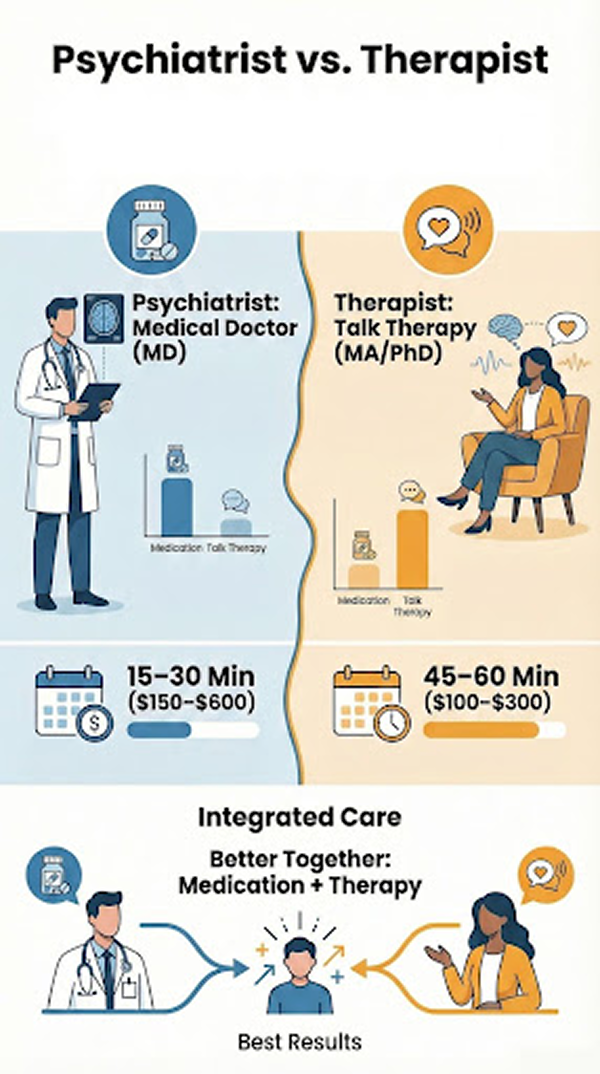
Navigating mental health care can be confusing when terms overlap. A psychiatrist is a medical doctor. They diagnose conditions and can prescribe medication, focusing on the biological aspects of mental health.
A therapist, such as a psychologist or counselor, provides talk therapy. They work with you on emotions, behaviors, and coping strategies.
The fundamental difference is medical training. This guide isn’t about which is superior, but about which is appropriate for your situation.
Keep reading to clarify your path to emotional well-being and make an informed choice for your care.
Key Takeaways
- Psychiatrists are medical doctors with prescription authority, focused on diagnosis and medication management.
- Therapists cannot prescribe medications (rare state-specific exceptions for prescribing psychologists).
- The most effective treatment plan often involves collaborative care from both professionals.
The Difference Between A Psychiatrist And A Therapist

The choice between a psychiatrist and a therapist often begins in a primary care office. A patient describes a persistent low mood or anxiety that rest can’t fix. The provider may suggest two paths.
It feels like a fork in the road, but it’s more like two lanes on the same highway. One lane is built on medical training, the other on psychological insight. The goal is to know which lane leads to the right destination, and sometimes, both are needed.
Consider a typical case: a patient with relentless, ritualistic thoughts. They might spend months in talk therapy, which is valuable work.
But if the compulsive behaviors continue, a psychiatric evaluation may be recommended to explore whether Obsessive-Compulsive Disorder (OCD) is present and to discuss appropriate medication options.
The Fundamental Difference: Medical School vs. Graduate School
Their training separates them from the start. A psychiatrist’s training starts with four years of medical school. There, they study the entire human body, including the brain and how medications work.
The benefits of psychiatry include not only medication management but also the ability to provide tailored treatment plans for complex mental health conditions. After medical school, they spend at least four more years in a psychiatric residency.
According to the University of the People, psychiatrists are trained medical doctors who can prescribe medication and monitor physical health [1].
Therapists are also highly trained professionals who assess, diagnose, and treat mental health conditions, but they do not attend medical school and therefore cannot prescribe medication.
Instead, therapists help patients through different types of therapy, while often collaborating with psychiatrists when medication is needed.
A therapist typically earns a Master’s degree, such as Social Work or Counseling, with training centered on psychotherapy techniques, human behavior, and emotional theory. Some professionals, like psychologists, hold Doctorates and may perform psychological testing.
This training gap leads to the main practical difference: prescription authority. A psychiatrist can prescribe medications such as antidepressants. A therapist, with very few exceptions, cannot. Their primary tool is therapeutic conversation.
When Should You Choose A Psychiatrist Over A Therapist?
Choose a psychiatrist when symptoms suggest a medical cause that may require medication.
If mental health issues make daily life hard, such as trouble getting out of bed, staying safe, or knowing what’s real, brain chemistry may be involved.
HelpGuide explains that because psychiatrists are medical doctors, they can evaluate both the physical and psychological aspects of mental health problems [2].
They are able to identify underlying medical conditions, such as thyroid issues that may trigger anxiety, and while some psychiatrists still provide therapy, most focus primarily on medication management.
Psychiatrists focus on severe or long-term mental health conditions. These often include schizophrenia, severe bipolar disorder with strong mood swings, or depression that has not improved with therapy alone. In these cases, medical treatment is often necessary.
A psychiatrist’s role includes several key functions:
- Diagnosing conditions using the clinical criteria of the DSM-5.
- Prescribing and managing medication regimens.
- Ordering and reviewing lab tests to rule out medical causes of symptoms
Their approach is focused on diagnosis and stabilizing the patient through pharmacological intervention.
The Healing Power of Talk and Behavioral Therapy

You seek out a therapist when the work involves the mind’s patterns, not just its chemistry. This is the realm of talk therapy.
If you are coping with grief, family conflict, repeated unhealthy behaviors, or the effects of trauma, a therapist provides a structured space to work through it. Their main tools are conversation, empathy, and proven techniques.
Therapists help you develop practical, real-world skills. Different professionals bring different approaches, depending on your needs:
- A Licensed Clinical Social Worker (LCSW) may use interpersonal therapy to strengthen relationships
- A Marriage and Family Therapist (MFT) focuses on family and household dynamics
- Therapists trained in Eye Movement Desensitization and Reprocessing (EMDR) help people work through traumatic memories, (e.g., PTSD). DPT often for Borderline Personality Disorder (BPD)
Sessions are usually longer, around 45 to 60 minutes, which allows time for deeper discussion. They operate from a biopsychosocial model, considering your environment, relationships, and internal world.
While therapists cannot prescribe medication, they offer consistent emotional support and tools for lasting change. Many also provide virtual or online therapy, making care more accessible.
Comparison of Qualifications and Treatment Methods
The distinction in training directly shapes the treatment methods. A psychiatrist’s appointment, often called a medication management session, might last 15 to 30 minutes. It’s a focused check on symptoms, side effects, and dosage efficacy. The therapist’s session is a different space entirely, a 45 to 60 minute dialogue designed to unpack and understand.
Consider the practical differences in approach:
| Feature | Psychiatrist | Therapist |
| Education | MD or DO (Medical School + Residency) | Master’s or PhD (Psychology, Social Work, Counseling) |
| Prescription Power | Yes, for psychiatric medications. | No, with rare state-specific exceptions. |
| Primary Tool | Diagnosis & Medication Management. | Talk Therapy (e.g., CBT, DBT, family therapy). |
| Session Focus | Symptom review, medication adjustment. | Emotional processing, skill-building, behavioral change. |
| Cost Without Insurance | $150-$600 (initial $350+) | $100-$300 |
The cost of a psychiatric consultation reflects specialized medical training. You are paying for a medical diagnosis and a treatment plan, which may include lab tests or brain imaging. A therapist’s fee, on the other hand, covers ongoing talk therapy and the long-term, one-on-one work of psychotherapy.
The Integrated Approach: Why You Might Need Both
Effective care often uses a shared approach. A psychiatrist handles medication, while a therapist focuses on talk therapy. Medication can alleviate acute symptoms, creating the stability needed for deeper therapeutic work.
This collaboration relies on a clear division:
- The psychiatrist focuses on diagnosis and medication management.
- The therapist provides talk therapy to build skills and process emotions.
- Together, they create a feedback loop for a unified plan.
The therapist reports on daily progress, allowing the psychiatrist to adjust treatment. The team approach recognizes that mental health is shaped by both brain chemistry and life experience. For severe depression, using therapy and medication together often works better than using just one.
Which Professional Is Better For Specific Conditions?

The choice often becomes clearer when you look at the condition itself. Psychiatrists are better suited for severe, biologically-driven disorders that require chemical intervention.
Therapists are especially helpful for mild to moderate anxiety, depression, and everyday stress. They focus on building coping skills and working through emotions.
For some diagnoses, the recommended path is more defined. Consider these guidelines based on clinical presentation:
Best for Psychiatrists
- Severe Bipolar Disorder: Managing manic and depressive episodes often requires mood stabilizers only a doctor can prescribe.
- Schizophrenia: Treatment typically involves antipsychotic medications and ongoing medical monitoring.
- Treatment-resistant Depression: When standard therapies fail, a psychiatrist can explore advanced medical options.
Best for Therapists
- Grief and Loss: Processing emotion and adapting to change is core therapeutic work.
- Relationship Conflict: Marriage and family therapists are trained in systemic dynamics.
- Phobias and Stress: Behavioral therapy techniques are highly effective for these issues.
Conditions Warranting Both
- Major Depressive Disorder & PTSD: Medication can ease severe symptoms. This makes it easier for therapy to focus on the deeper causes.
- ADHD: Medication manages focus, while therapy builds organizational and coping skills.
- Borderline Personality Disorder: Medication may help with mood swings, while specialized therapy is the cornerstone for emotional regulation.
FAQ
What is the main difference between a psychiatrist and a therapist?
Psychiatrists are medical doctors who complete medical school, diagnose mental health conditions, and prescribe medication for illnesses such as bipolar disorder or Major Depressive Disorder.
Therapists provide talk therapy and behavioral therapy to support emotional well-being. Both are mental health professionals, but psychiatrists focus on medication management, while therapists guide patients through structured therapy sessions and evidence-based treatment methods.
Who should I see first for mental health support?
Many people start with a primary care provider or behavioral health specialist for an initial consultation. They review symptoms and recommend psychiatric care or therapy.
Therapists help with emotional support and behavioral patterns. Psychiatrists evaluate brain chemistry, confirm psychiatric diagnoses, and provide pharmacological intervention.
Your choice depends on symptom severity, treatment goals, and whether medication may be needed.
What types of therapy do mental health counselors provide?
Mental Health Counselors, Licensed professional counselors, and Clinical Social Workers offer cognitive behavioral therapy, Dialectical behavior therapy, acceptance and commitment therapy, interpersonal therapy, and group therapy.
Some also use Eye Movement Desensitization and Reprocessing. These psychological interventions address trauma, anxiety, Obsessive-Compulsive Disorder, and relationship challenges while improving emotional well-being through consistent therapy sessions.
Can therapists diagnose mental illness or prescribe medication?
Therapists, including Licensed Marriage and Family Therapists and Licensed clinical social workers, cannot prescribe medication.
They provide mental health services such as family therapy, online therapy, and virtual sessions.
Psychiatrists diagnose mental illnesses, order laboratory tests or brain imaging studies, and manage chemical imbalances. Therapists focus on behavioral health strategies and long-term emotional support.
How do psychiatrists build treatment plans for complex conditions?
Psychiatrists follow a biopsychosocial model that considers mental illness history, substance use disorders, emotional health, and behavioral patterns. They may combine medication management with outpatient care and psychological testing.
For conditions like ADHD, PTSD, or Borderline Personality Disorder, psychiatrists monitor progress, adjust medications, and coordinate mental health services across the broader mental health system.
Your Next Step in Mental Health Care
The difference between a psychiatrist and a therapist is a guide, not a barrier. Psychiatrists treat brain chemistry with medical care. Therapists help change emotional and behavior patterns. Many people benefit from both. If symptoms feel biological, such as severe mood swings, intense anxiety, or intrusive thoughts, a psychiatric evaluation is an important first step.
For accessible psychiatric care, including medication management for depression, anxiety, and ADHD, consider MedPsych Integrated in Raleigh and Cary, NC. They accept Aetna and the NC State Health Plan, with no waitlist.