

Choosing a good psychiatrist starts with checking both their medical training and how well they fit your specific needs.
Choose a psychiatrist who is a licensed medical doctor, board-certified in psychiatry, and experienced with your specific condition.
They should explain things clearly and treat you with respect. Practical details like location, availability, and insurance also play a role. All of this shapes how workable the relationship will be.
Keep reading for a clear, step‑by‑step guide to making this decision with confidence.
Key Takeaway
- Verify board certification and relevant subspecialty training for your specific condition.
- Prioritize a psychiatrist whose communication style fosters trust and collaborative decision-making.
- Ensure practical factors like insurance coverage, availability, and treatment approach align with your circumstances.
Verifying Essential Credentials and Training

The image depicts a woman intently focused on a tablet device, suggesting the modern, technology-driven approach to researching and identifying qualified mental health providers.
A good first step is to look closely at a psychiatrist’s training. A qualified psychiatrist is a licensed medical doctor, either an MD (Doctor of Medicine) or a DO (Doctor of Osteopathic Medicine), which is essential for delivering the full benefits of psychiatry such as accurate diagnosis, safe medication management, and coordinated long-term care.
After medical school, they should complete a four‑year psychiatry residency. An important extra sign of quality is board certification by the American Board of Psychiatry and Neurology (ABPN).
This means they passed thorough exams and chose to meet national standards for knowledge and clinical practice.
Patients should not hesitate to verify these details. You can check a psychiatrist’s board certification and active medical license on the ABPN website and your state medical board’s site. [1]
These databases also often list any past disciplinary actions or malpractice cases. Try to look at this information calmly and in context, instead of treating it as an automatic reason to avoid the doctor.
If you need care for a child, teenager, or an older adult, try to find a psychiatrist with extra training in child and adolescent psychiatry or geriatric psychiatry. That added training means they have deeper experience with the needs of those age groups.
Assessing Specialization and Treatment Philosophy

The image depicts a professional, personable interaction between a psychiatrist and patient, suggesting the importance of finding a mental health provider with strong interpersonal skills and a collaborative approach.
Psychiatry is not a single, uniform specialty. Many psychiatrists specialize in certain conditions, and understanding when to see a psychiatrist can help you identify whether your symptoms call for specialized medical treatment rather than general counseling alone.
Picking a psychiatrist who regularly treats your main problem can make your care much more effective.
Clinical focus and conditions treated
- Ask which problems they treat most often, such as mood disorders, anxiety, OCD, PTSD, or psychotic disorders.
- A psychiatrist who frequently treats your primary condition is more likely to be comfortable with nuanced medication choices and long‑term management.
Treatment philosophy
- Some practice a primarily biological model, focusing on:
- Diagnostic assessment
- Medication selection and dose adjustment
- Monitoring side effects and physical health
- Others use an integrated model, combining:
- Pharmacotherapy
- Close coordination with psychotherapy (CBT, DBT, exposure therapy, etc.) [2]
- Collaboration with other clinicians, such as psychologists or social workers
Evidence-based practice
- Ask how they choose treatments:
- Do they rely on clinical guidelines and research data?
- Are they familiar with current evidence for your specific diagnosis?
- A clear reference to evidence‑based care suggests a structured, thoughtful approach rather than trial‑and‑error alone.
Style of decision-making
- Clarify whether they tend to be:
- Collaborative – discussing options, risks, and preferences with you, and making decisions together.
- More directive – offering firm recommendations and expecting you to follow a clear plan.
- Choose the style that best matches how you like to participate in your own care.
These questions are good to ask at a first visit. They help you see not only if the psychiatrist is skilled, but also if the way they work feels right for you.
Evaluating Communication Style and Therapeutic Rapport
A good psychiatrist-patient relationship is just as important as the treatment plan. This therapeutic alliance strongly affects how likely you are to follow treatment and feel better over time, especially in areas like professional stress, where how psychiatrists help with work anxiety often depends on clear communication, trust, and collaborative decision-making.
You should feel listened to, taken seriously, and treated with respect. The psychiatrist should show real attention, kindness, and be able to explain medicines and side effects in clear, simple language.
The first visit is a good time to test this. Notice if the psychiatrist asks careful questions about your symptoms, past treatment, health history, and goals.
They should respond to your worries without brushing them off. If they seem rushed, interrupt often, or give you a plan without asking what you think, that may be a concern.
A good fit feels like working together: the doctor brings medical knowledge, and you bring your experience and values.
| Communication Aspect | Positive Indicator (Green Flag) | Negative Indicator (Red Flag) |
| Listening | Ask clarifying questions and summarize your points. | Frequently interrupts or seems distracted. |
| Explanations | Provides clear rationale for treatment recommendations. | Uses excessive jargon without clarification. |
| Collaboration | Discuss options and incorporate your preferences. | Presents a single treatment path as non-negotiable. |
| Empathy | Acknowledges the difficulty of your experience. | Appears detached or overly clinical. |
Analyzing Logistical and Practical Considerations
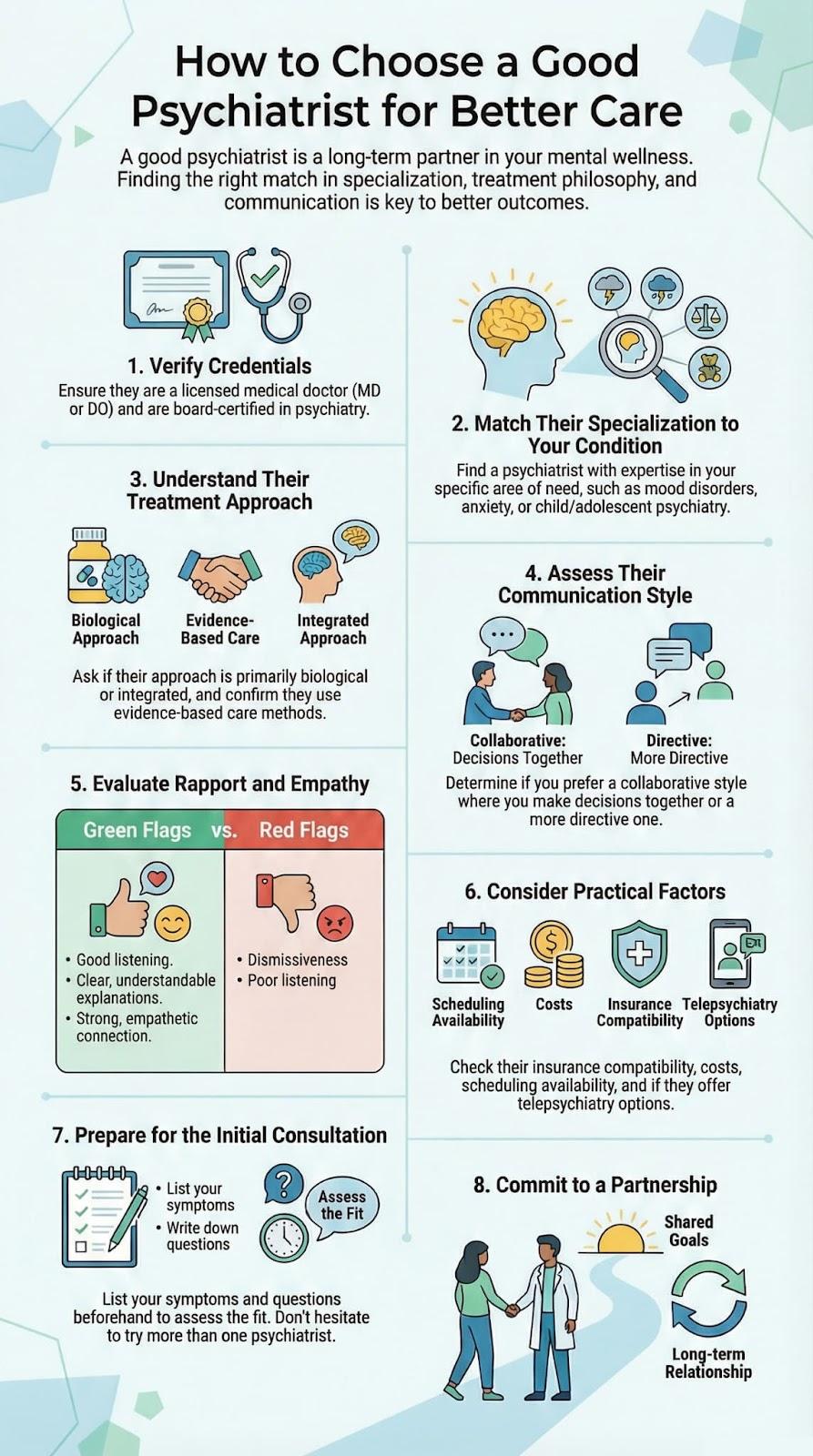
Even when a psychiatrist is well trained and feels like a good match, practical details can still limit how well treatment works. It helps to look clearly at cost, access, and visit format before you decide.
- Insurance and cost
- Confirm whether the psychiatrist is in‑network for your insurance plan.
- Ask about copayments, deductibles, and any limit on the number of covered visits.
- If they are out‑of‑network or you are paying yourself, ask for the full fee per session, whether there is a sliding scale, and how and when payment is collected.
- Scheduling and availability
- Ask how long the wait is for a first appointment. A brief delay is common, but several months may not be realistic if your needs are urgent.
- Clarify how often they usually schedule follow‑up visits.
- Ask what to do for urgent issues or medication problems between sessions (for example, phone calls, secure messages, or nurse support).
- Visit format and access
- Find out if they offer telepsychiatry, video or phone visits, as well as in‑person care.
- Think about how this fits with your work schedule, travel time, mobility, or if you live far from clinics.
- A flexible mix of in‑person and virtual visits can make it easier to stay consistent with treatment over time.
Conducting the Initial Consultation and Making a Decision

The scene depicts a well-appointed office environment, hinting at the value of considering a psychiatrist’s level of expertise and the quality of their practice when choosing a mental health specialist.
The first visit with a psychiatrist is not just for them to learn about you, it is also your chance to see if they are a good fit. Think of it as a focused meeting, not a casual talk.
Before your visit, write down your main symptoms, when they started, any past mental health care or hospital stays, and the medicines you take now.
During the session, notice practical points, cost, schedule, and whether in‑person or online visits fit your life. Also pay attention to how you feel with them. Do you feel respected, not rushed, and able to talk about hard topics?
It is completely fine to meet with more than one psychiatrist before you decide who you want to keep seeing.
If, after 4-6 weeks, you still feel stuck, see no real progress, find communication hard, or strongly disagree with the plan, it is reasonable to look for another doctor. Getting a second opinion at that point is a careful, responsible step, not a failure.
FAQ
What qualifications should I look for when choosing a psychiatrist?
Look for a medical doctor who is board certified and trained through a psychiatry residency program. This shows a strong clinical background in mental health conditions and medication management.
Experience with anxiety disorders, bipolar disorder, or substance abuse can matter depending on your needs. A clear credential review helps ensure safe, professional mental health care.
How important is communication style in mental health treatment?
Communication style matters a lot in mental health care. A good psychiatrist listens carefully, explains treatment approaches clearly, and respects your concerns.
Open dialogue supports accurate clinical interviews, better treatment plans, and long-term mental well-being.
Feeling comfortable asking questions improves trust and helps you stay engaged during in-person sessions or virtual appointments.
Should I choose a psychiatrist based on treatment approaches offered?
Yes, treatment approaches should match your needs. Some psychiatrists focus on medication management, while others combine talk therapy, psychological interventions, or behavioral health strategies.
Ask about personalized treatment plans, support groups, and options for treatment-resistant depression. A flexible therapeutic approach often leads to better outcomes and improved mental health over time.
How do insurance coverage and costs affect psychiatrist selection?
Insurance coverage can strongly influence access to care. Check whether the psychiatrist accepts your insurance provider and review coverage details in insurance directories.
Understanding costs for consultations, ongoing sessions, and virtual mental health treatment helps avoid stress later.
Clear financial expectations allow you to focus on recovery instead of worrying about unexpected expenses.
Can virtual psychiatry services be as effective as in-person sessions?
Virtual psychiatry services can be effective for many mental health conditions. Telemedicine services allow access to care near you without travel, using video conferences or virtual appointments.
For some patients, online psychiatry services improve consistency and comfort. Effectiveness depends on your medical history, condition severity, and preference for in-person or remote care.
Committing to a Collaborative Treatment Journey
Choosing a psychiatrist starts a long‑term process, not a one‑time visit. You want a doctor who can be a steady guide and partner, who explains things clearly and works toward the same goals you have. Together, you build a treatment plan that may use medicine, therapy, and simple changes in daily habits.
At MedPsych Integrated, our board‑certified providers emphasize collaborative, individualized care, with telepsychiatry and insurance partnerships to make access easier. Choosing a psychiatrist who fits your needs can improve treatment outcomes and long-term engagement.
References
- https://www.abpn.com/faq/what-is-abpn-certification/
- https://pmc.ncbi.nlm.nih.gov/articles/PMC2732196/
Related Articles
- https://medpsychnc.com/benefits-of-psychiatry/
- When To See A Psychiatrist
- How Psychiatrists Help With Work Anxiety Symptoms